
The geopolitics of the conflict with the United States and Europe
“Not all wars begin with gunfire… some begin with geographical location.”
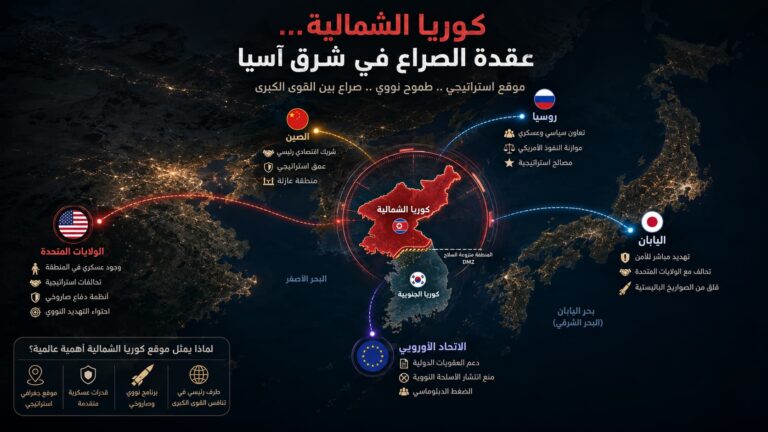
Although North Korea is not among the world's largest countries in terms of area or economy, it has managed over more than seven decades to establish itself as one of the most complex issues in international politics. Since the end of the Korean War in 1953, the Korean Peninsula has become one of the most dangerous geopolitical hotspots, where the interests of the United States, China, Russia, and Japan intersect, while the European Union supports policies of sanctions and nuclear non-proliferation.
North Korea's importance lies not in its size or economic capabilities, but in its strategic geographic location, which has made it a focal point of international conflict whose effects extend far beyond East Asia. This small country has become an influential element in nuclear deterrence equations, military balances, and competition among major powers, to the point that any escalation there has the potential to impact global security and the economy.
In this report, we examine how North Korea’s geographical location has become one of the most important factors in international conflict, why this small country continues to pose a persistent challenge to the world’s largest powers, and what the possible scenarios are for the future of one of the most complex crises of the 21st century.
First: Geographical location… the key to the conflict
A nation's power is not always determined by its population or economy, but may also lie in its geographical location. This is certainly true of North Korea, which has become one of the world's most sensitive flashpoints due to its strategic geographic position in Northeast Asia, where the interests of major international powers directly intersect.
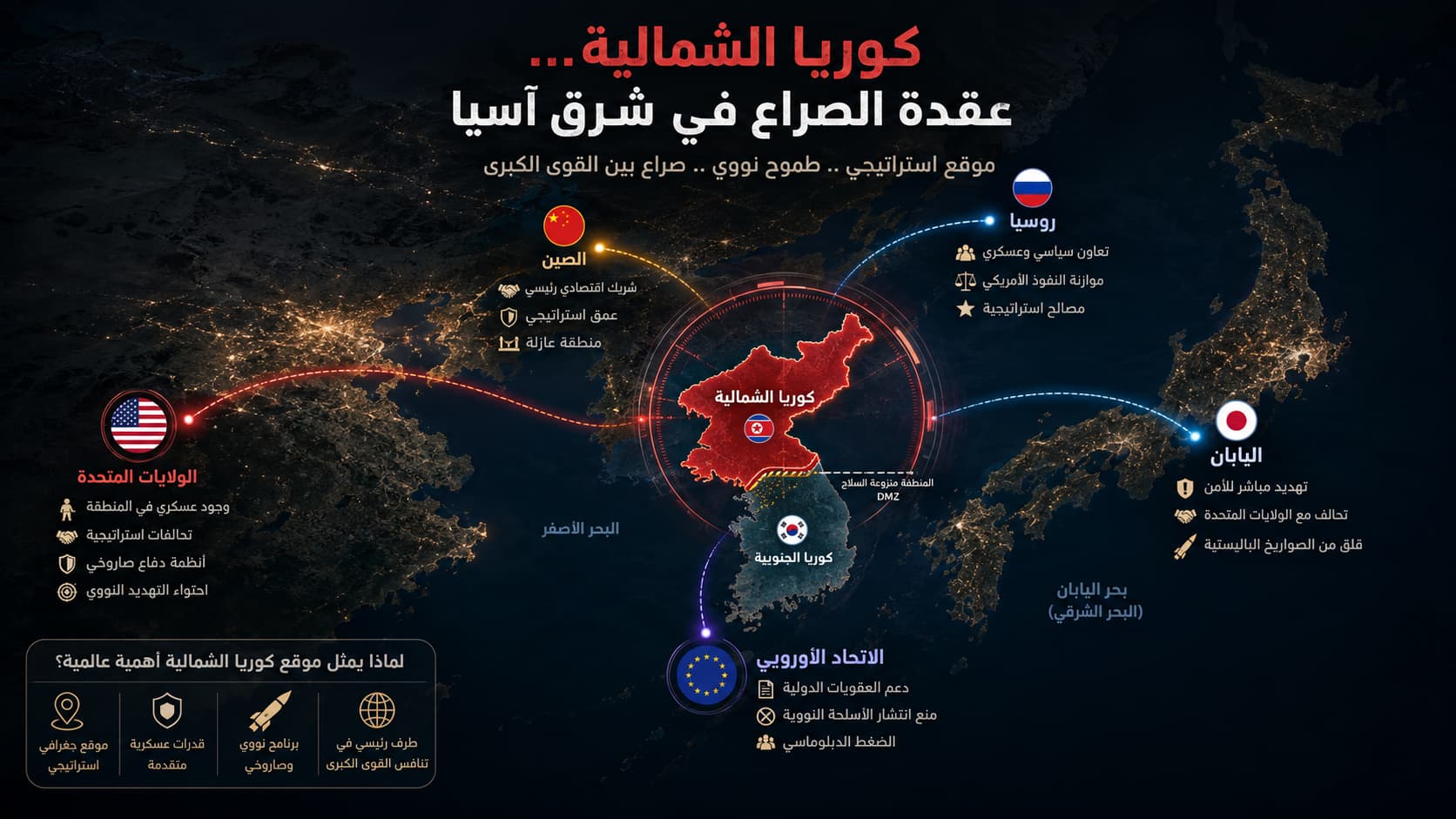
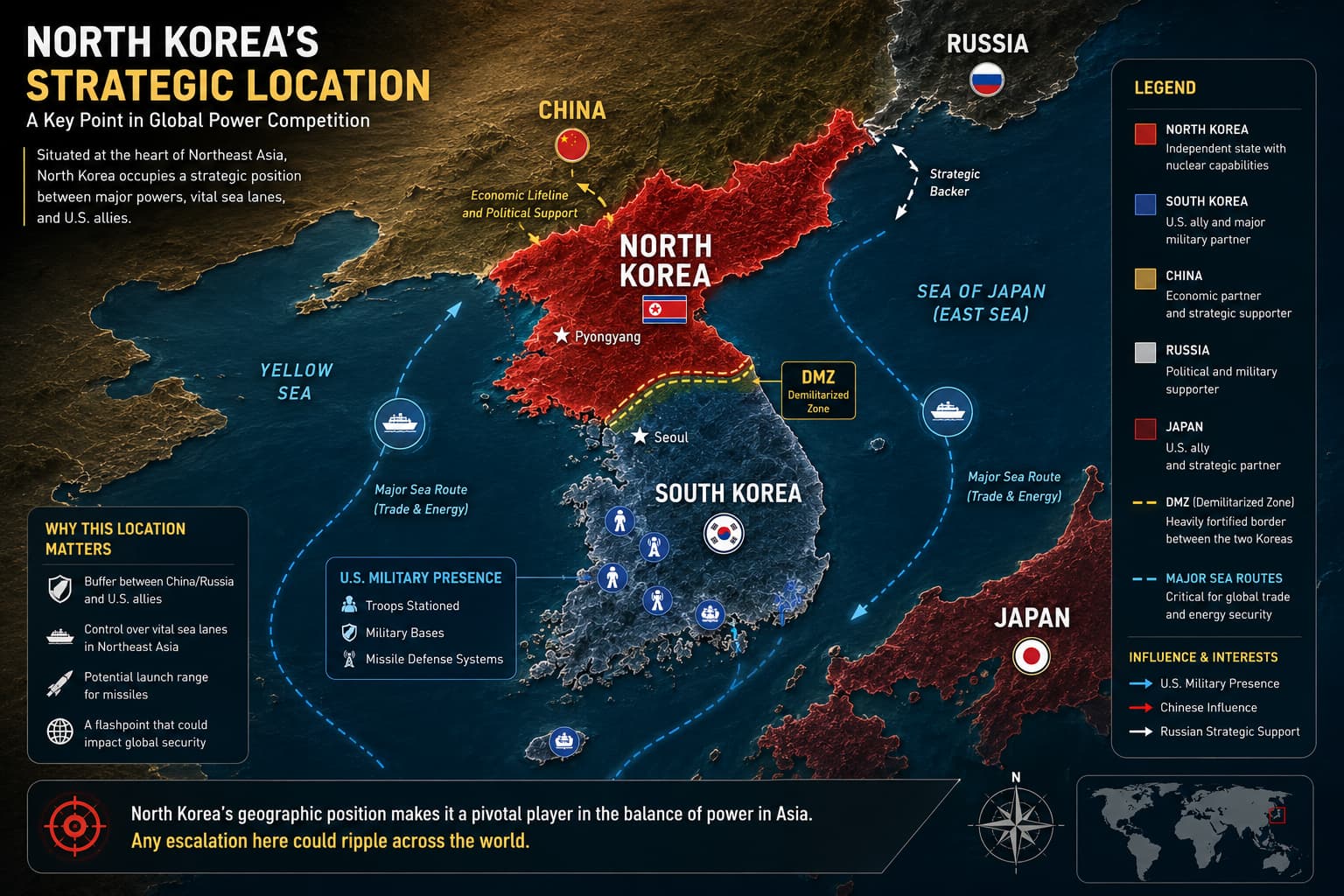
North Korea lies between China and Russia to the north, while it is separated from South Korea by [unspecified means]. Demilitarized Zone (DMZ)It has one of the most heavily fortified and militarized borders in the world. It also borders the Yellow Sea to the west and the Sea of Japan (East Sea) to the east, giving it a strategic location on one of Asia's most important maritime and economic routes.
This geography makes North Korea a buffer state between Chinese and Russian influence on one side, and the network of US military allies in East Asia, primarily South Korea and Japan, on the other. Therefore, the Korean Peninsula is viewed not only as a regional conflict, but also as a key focal point in the global balance of power, where any shift in this balance could have repercussions for the security and stability of the entire Indo-Pacific region.
While Washington sees maintaining its military presence in the region as necessary to protect its allies, ensure freedom of navigation, and deter nuclear threats, Pyongyang considers this presence a direct threat to its national security, which makes the geographical location itself one of the most prominent reasons for the continuation of the crisis for more than seventy years.

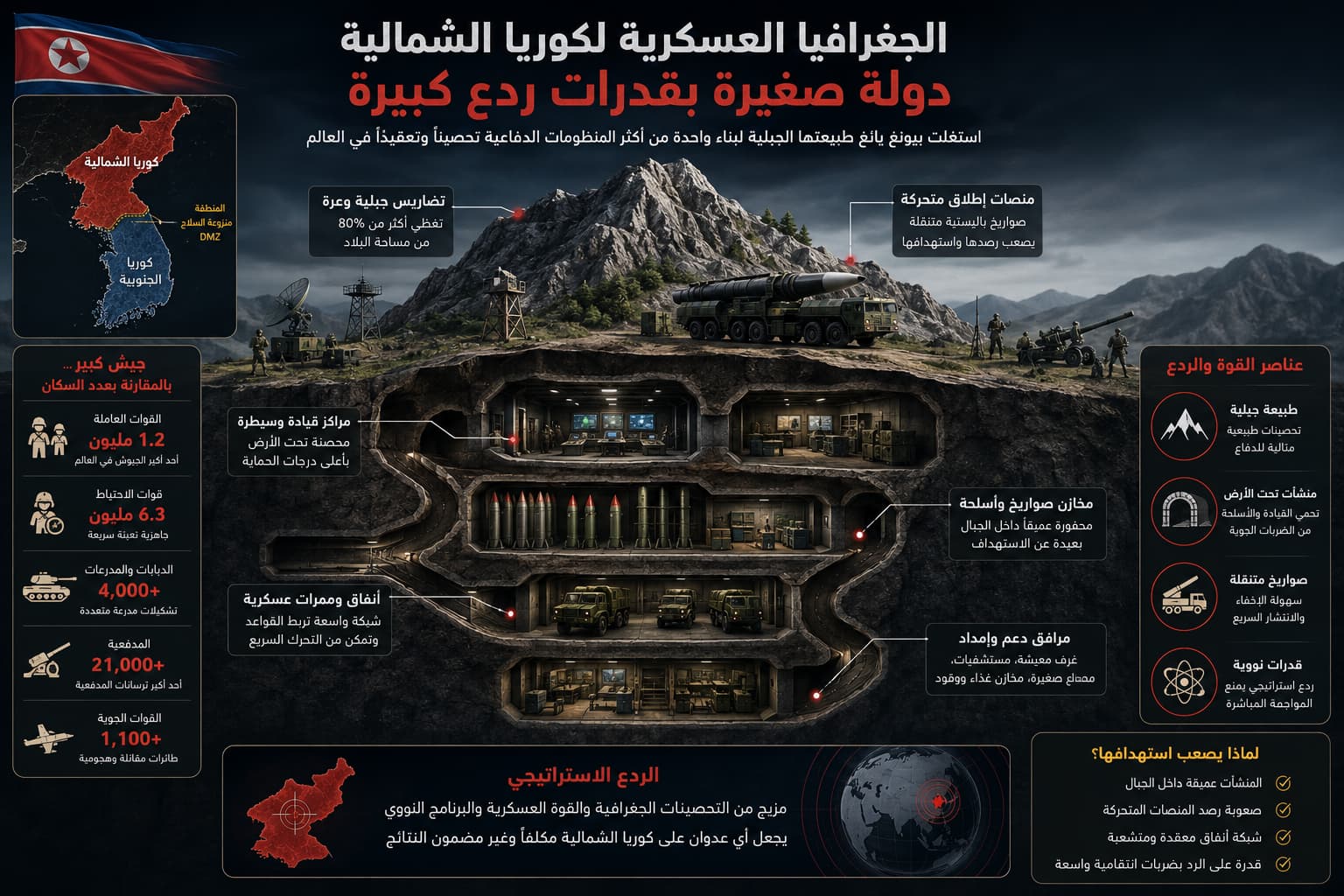
Second: Military Geography... A small state with significant deterrent capabilities
North Korea's strength does not depend on the size of its economy or its natural resources, but rather on its ability to utilize its rugged geography as a key component of its military strategy. The mountainous terrain that covers most of the country has facilitated the creation of an extensive network of tunnels, fortified military installations, and underground bases, granting it a significant capacity to conceal military equipment and protect it from airstrikes and space-based reconnaissance.
North Korea is estimated to possess one of the world's most fortified defense systems, with hundreds of military sites nestled within mountains, along with mobile ballistic missile launchers that are difficult to track or target before use. This military infrastructure is a key deterrent, making any military action against it extremely complex and costly.
North Korea's deterrent capabilities extend beyond its fortifications; it also boasts one of the world's largest armies relative to its population, along with a sophisticated missile program and nuclear capabilities that have made the country an indispensable player in regional and international security equations. Possessing these capabilities means that any potential confrontation would not be confined to the Korean Peninsula but could extend to major international powers, which explains the eagerness of all parties to avoid sliding into direct conflict.
Third: The United States... a policy of containment and deterrence
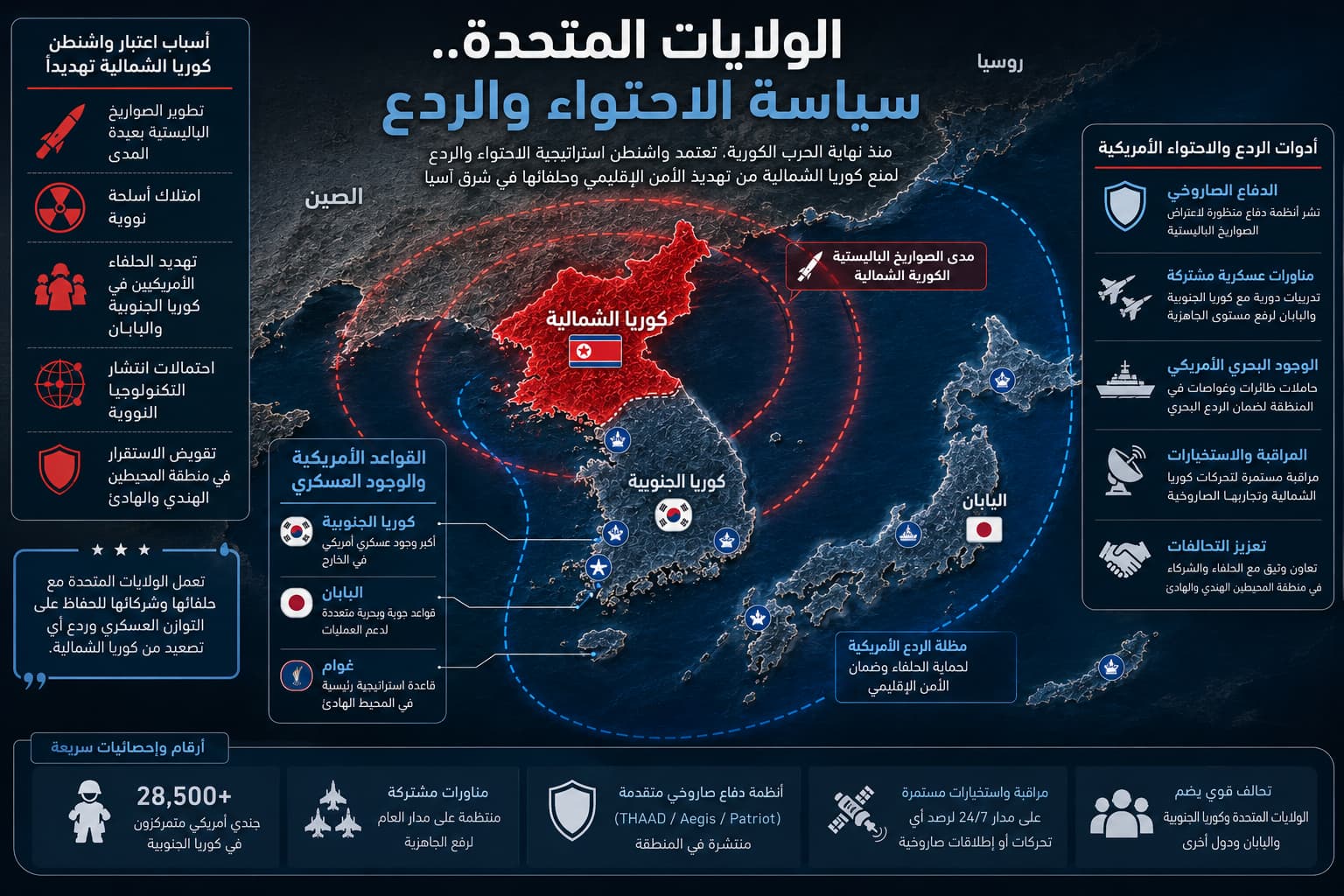
Since the end of the Korean War, the United States has viewed North Korea as one of the most complex security challenges in East Asia. Pyongyang's continued development of its missile and nuclear programs, coupled with its ability to threaten U.S. allies in the region, has made it a permanent fixture in U.S. defense strategy in the Indo-Pacific region.
Washington's policy is based on the principle “Containment and deterrence”By maintaining a substantial military presence in South Korea and Japan, deploying missile defense systems, and conducting regular joint military exercises, the United States aims to reassure its allies and deter any potential escalation by North Korea. The US also works to strengthen security and intelligence cooperation with its regional partners to continuously monitor military movements and missile tests.
In contrast, Pyongyang views this military buildup as a direct threat to its sovereignty and national security, and considers the joint military exercises preparations for an attack. This compels it to continue developing its military and missile capabilities as the primary guarantee of the regime's survival and the achievement of strategic deterrence. Thus, the cycle of mutual escalation continues, with each side viewing its actions as defensive, while the other sees them as a threat requiring a response. The Korean crisis remains one of the most persistent
.Security crises are becoming more complex and persistent in the world.
Fourth: Europe... a partner in international pressure
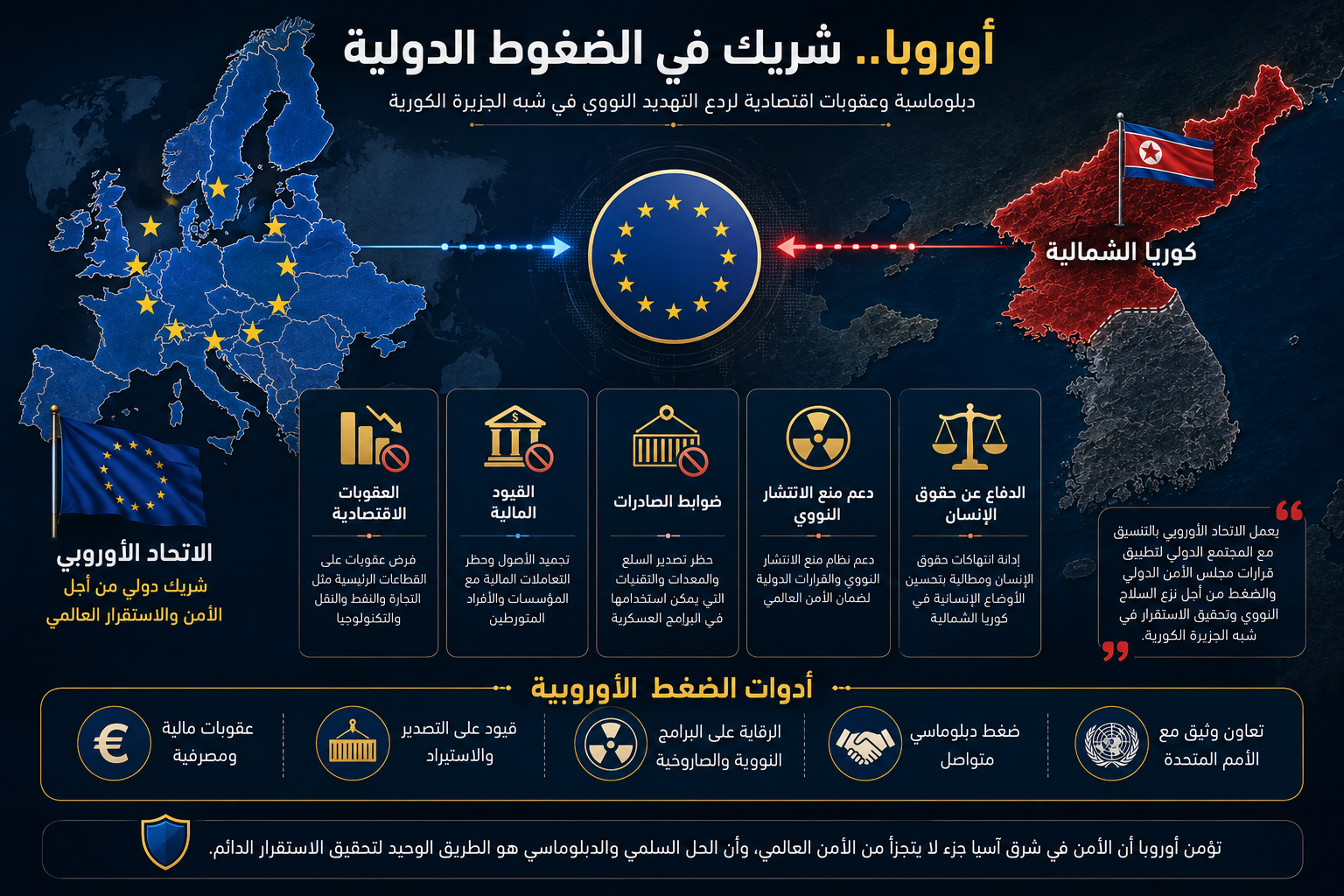
Despite the geographical distance separating Europe from the Korean Peninsula, the European Union has become an active player in managing the North Korean crisis, not through a military presence, but through diplomatic tools, economic sanctions, and continued support for international efforts aimed at reducing the spread of nuclear weapons.
The European Union adopts a position consistent with UN resolutions regarding North Korea, participating in the imposition of economic and financial sanctions, supporting the nuclear non-proliferation regime, and repeatedly condemning nuclear tests and ballistic missile launches, in addition to consistently raising human rights concerns within the country. The EU believes that any escalation on the Korean Peninsula not only threatens regional security but could also impact global economic stability, supply chains, and international trade.
In contrast, Pyongyang views these policies as an extension of Western positions supporting the United States, and considers European sanctions part of a policy of international pressure and isolation imposed on it for years. Therefore, the confrontation is not limited to the military dimension, but also extends to the political, economic, and diplomatic arenas.
.Europe has become an influential player in one of the world's most complex geopolitical crises.
Fifth: Economic sanctions... the West's weapon
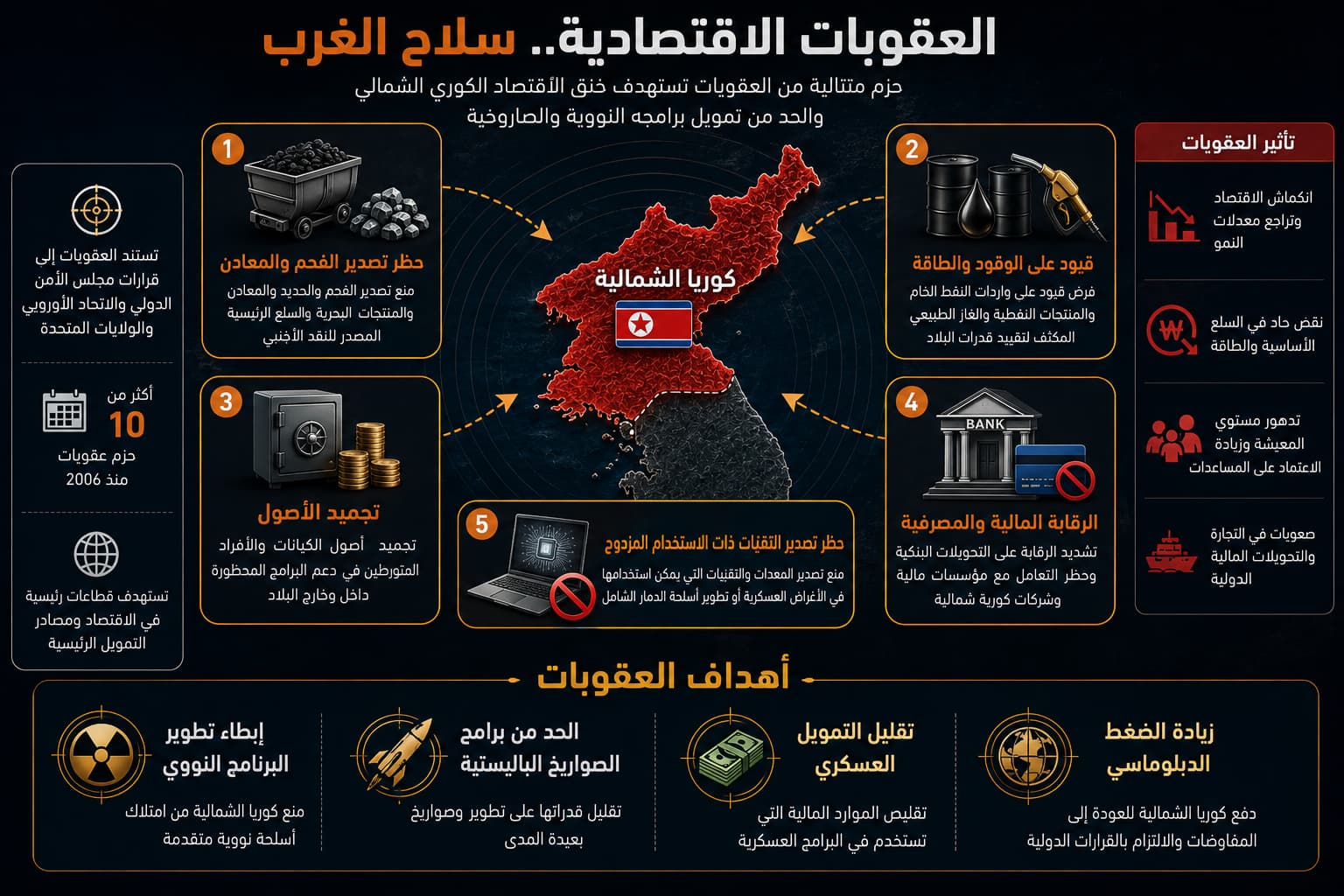
The confrontation between North Korea and the West has not been limited to military balances, but has extended to a broad economic front, where international sanctions have become one of the most prominent tools of pressure used to curb the development of nuclear and missile programs. For years, the United States, the European Union, and the United Nations have imposed successive rounds of sanctions targeting vital sectors of the North Korean economy, with the aim of reducing funding sources and slowing the pace of military development.
These sanctions included a ban on coal and mineral exports, restrictions on fuel and energy imports, a freeze on financial assets, stricter controls on bank transfers, and a ban on the export of dual-use equipment and technologies that could be used in military programs. Restrictions also extended to certain maritime and commercial activities linked to North Korea, in an effort to further isolate the country economically.
In contrast, Pyongyang maintains that these sanctions are more of a tool for political pressure than a means of achieving international security, and views them as targeting its sovereignty and its right to develop its defense capabilities. Despite the clear economic impact, the sanctions have thus far failed to halt North Korea's nuclear program, reflecting the complexity of the crisis and the ongoing disagreement over the best way to address it.
Sixth: China and Russia... North Korea's strategic depth
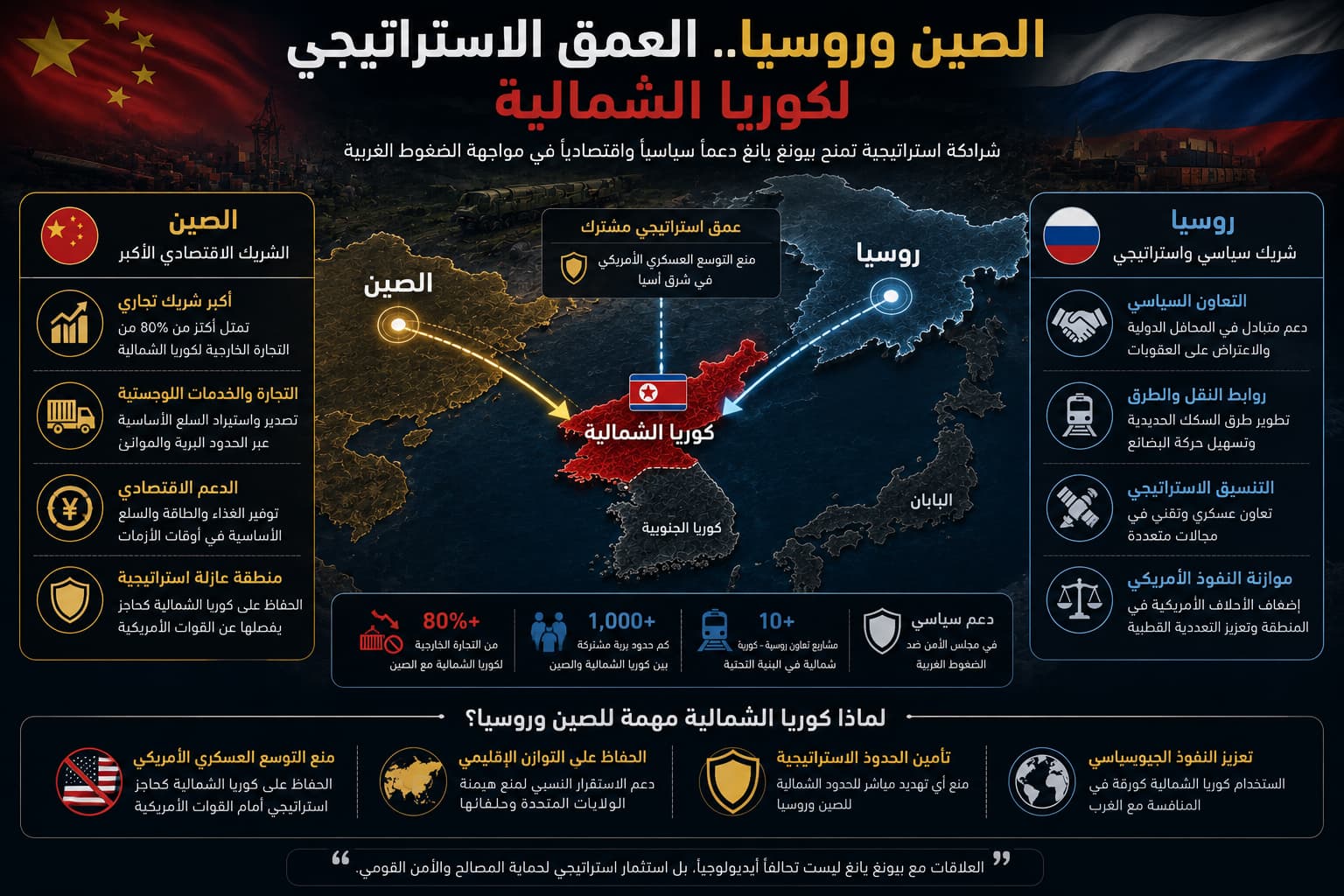
North Korea's ability to withstand Western pressure cannot be understood without considering its close ties with China and Russia, which represent its economic and strategic depth. China is Pyongyang's largest trading partner, while Russia has strengthened its cooperation with North Korea in recent years amid the rapid transformations of the international system.
For Beijing and Moscow, North Korea's importance extends beyond bilateral relations to its geographic location as a buffer zone separating their borders from the US military presence in South Korea and Japan. Therefore, both China and Russia view North Korea's stability as crucial for maintaining strategic balance in Northeast Asia and preventing the expansion of US military influence near their borders.
Conversely, this political and economic support grants North Korea greater room to maneuver in the face of Western sanctions and pressure, transforming the Korean crisis into a part of global competition between major powers, rather than simply a regional conflict within the Korean Peninsula. This is especially true as tensions escalate between the United States and China.
.On the other hand, Russia has seen North Korea become increasingly important in international balance of power calculations.
Conclusion
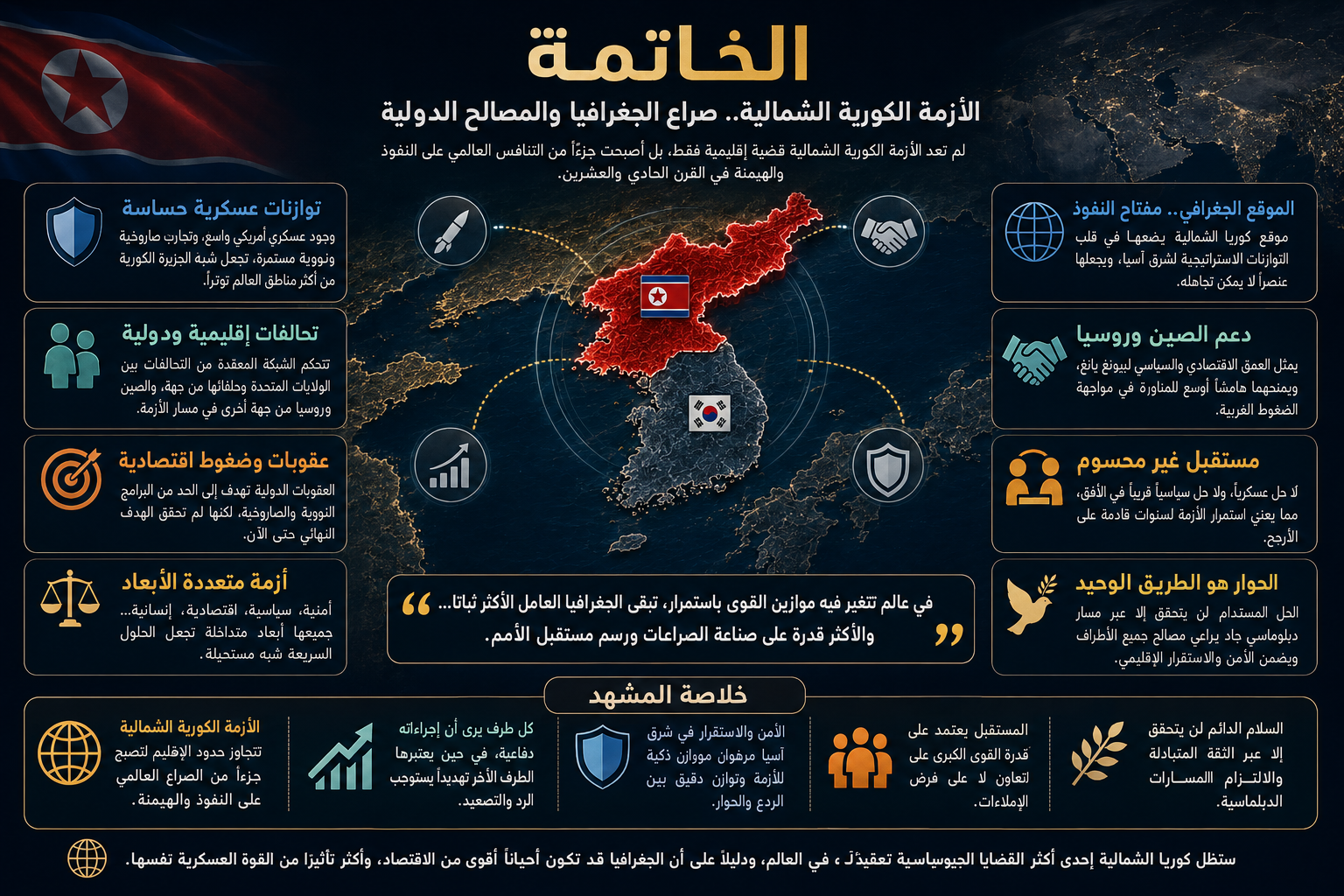
The North Korean crisis is not merely a political dispute or a territorial conflict; it has become a clear example of how geography can transform a resource-limited state into an influential player in international security equations. Military balances, nuclear deterrence, regional alliances, and great power competition have all made the Korean Peninsula one of the world's most volatile and persistently tense regions.
Despite ongoing economic sanctions and diplomatic pressure, North Korea remains at the heart of the geopolitical landscape, leveraging its strategic location and its relationships with China and Russia, while the United States and its allies continue their policy of containment and deterrence to prevent any shift in the regional balance of power. This reflects the fact that the crisis is no longer confined to the Korean Peninsula alone, but has become part of the global competition for influence and dominance in the 21st century.
The future of the crisis remains contingent on the ability of international actors to find a balance between the demands of security and stability and political and diplomatic dialogue. Until this is achieved, North Korea will remain one of the world's most complex geopolitical issues, and a testament to the fact that geography can sometimes be more powerful than economics and more influential than military might itself.
“In a world where the balance of power is constantly changing, geography remains the most constant factor… and the most capable of creating conflicts and shaping the future of nations.”